rodeo-cli: Architecture & design
Technical reference for contributors and maintainers. For deploying a workshop, see User guide.
Version: 0.34.0 License: GPL-3.0-or-later
What rodeo-cli is
rodeo-cli deploys the infrastructure for a rodeo: a live, hands-on workshop where attendees work against real systems. It builds a lab of nested KVM VMs on a single Linux host, driven by a declarative plan, you pick a profile, it converges the host.
The stack it builds depends on the chosen engine type (see Engine types & profiles):
suse-virt: a 3-node Harvester HCI cluster (+ optional Rancher Prime)rancher: Rancher Prime on K3s plus K3s/RKE2 clusters Rancher provisions on lab VMs (rancher-testis the 2-cluster variant)suse-edge: Rancher Prime + Elemental + Edge Image Builder + edge nodes
Every profile shares the same foundation: host networking, firewalld DNAT, DNS, storage, and phase orchestration on nested KVM/libvirt. The tool runs on cloud instances, Instruqt builder VMs, local VMs, or bare metal, anywhere you have KVM and enough RAM/disk.
Design goals
| Goal | How it is met |
|---|---|
| Declarative lab definition | rodeo-plan.yaml + secrets + -P / --paramfile |
| Plan before apply | rodeo plan (read-only diff vs host) |
| Safe resume | Per-plan state, --from PHASE, --force |
| One orchestrator | DeployRunner: no duplicated TUI/plain/bash paths |
| Host setup is idempotent | Ansible roles kvm_host + vms + pxe_server |
| Long waits are cancellable | threading.Event + process groups in poll loops |
| Instruqt-safe builds | deployment_target: instruqt skips finalise; hostimage boot uses start-if-needed |
| Self-contained install | Ansible roles bundled in rodeo/data/ansible/ |
| Minimal first-phase friction | scripts/bootstrap-sles.sh (curl |
| Graceful stop/restart + host reset | rodeo stop/start (infra-aware from definition: infra_type, components, start_order; graceful ACPI + host services; restartable). clean --all --hard --secrets --force-network for full reset (VMs/networks/states/passwords; no package removal). Clean runs stop first unless --hard. |
| Interactive definition generation | rodeo generate (templates base via parameter collection for hybrid customization, produces full config-dir yaml skeleton with project conventions like infra_type; post-validation via load_config; next steps for bootstrap/deploy/stop/start/clean lifecycle). Enables consistent entry to declarative model (definition as source for inventory/renderer/phases). |
Vision (roadmap): Declarative lab deployment, declare desired state, preview diff, converge, destroy what you own. See ROADMAP.md.
Two-dimension model
rodeo-cli has two independent axes that combine to produce a lab deployment:
Tech platform  ×  Host context  =  lab deployment

suse-edge          baremetal        SUSE Edge 3.7 on bare metal KVM
suse-edge          instruqt         SUSE Edge 3.7 on Instruqt KVM
suse-virt          instruqt         SUSE Virtualization on Instruqt KVM
rancher            aws              Rancher on an AWS EC2 KVM host
Tech platform: what lab topology and software stack to deploy. Encoded in rodeo/profiles/<name>.py + data/platforms/<name>/definition.yaml. Platform code is host-agnostic; the same profile works on any host context.
Host context: where the KVM host runs and what that implies for host-level setup. Encoded in deployment_target in rodeo-plan.yaml. Affects: guarded phases, firewall/DNAT configuration, external IP detection, success screen output, and infra adaptation (rodeo/host_context.py): resource floors, disk backend, guest cache/io. Acquire can be provisioned or BYO; both converge through the same overlays. The underlying infrastructure is always KVM/libvirt regardless of host context.
deployment_target |
Host type | Key differences |
|---|---|---|
baremetal |
Linux bare metal with KVM | full firewalld + DNAT; optional disk-space warn |
instruqt |
Instruqt managed KVM builder | finalise guarded; vCPU/RAM presets (~70% host) |
aws |
Provisioned EC2 or BYO on EC2 | provider: + destroy; disk_gb floor 500/Harvester-node, 60/Rancher-node (flat); NVMe → image_dir |
gcp |
GCE VM with nested KVM | ephemeral external IP; per-lab VPC firewall rule; native maxRunDuration dead-man switch |
Two install roles. install.sh installs a KVM host on SLES 16 / Leap 16 (/opt/rodeo-cli, system packages, a venv with system site packages for the libvirt binding) and a control machine everywhere else (macOS, other Linux: no root, an isolated venv with the [aws] extra, a private Python via a pinned uv when the system one is older than 3.10). rodeo/hostos.py makes the same call at run time: on a machine that cannot host labs, rodeo up without --target aws and rodeo deploy stop with the reason instead of failing halfway (RODEO_ALLOW_ANY_KVM_HOST=1 overrides). lab-in-a-box profiles are left to the plugin.
Cloud dead-man switch. Every EC2 instance rodeo creates (single host, fleet hosts, portal VM) goes through AwsHostProvider._run_instances_kwargs, which sets InstanceInitiatedShutdownBehavior: terminate, tags the expiry as rodeo-expires-at, and adds a cloud-init systemd timer (rodeo-deadman.timer, absolute UTC time, Persistent=true) that powers the guest off. provider.ttl_hours (default 6, at most 168) lengthens it. Only kvm-hosts labs deployed with fleet may turn it off (ttl_hours: off): the fleet inventory loader checks the lab type and marks the provider config, every other path refuses off. Those hosts are tagged rodeo-expires-at: never and stop instead of terminating on an in-guest poweroff. Logic in rodeo/providers/deadman.py.
AWS provider defaults. With no provider: block, rodeo up --target aws fills region ($RODEO_AWS_REGION, else eu-north-1), subnet_id (the default VPC's public subnet in an AZ that offers the instance type) and the catalog instance, and persists them to the plan for re-runs and destroy --cloud.
Vocabulary (keep these straight)
| Term | Meaning | Where it lives |
|---|---|---|
| Control plane acquire | Laptop provisions (or reuses) a cloud KVM host, waits for SSH, then remote-runs deploy | rodeo up --target aws / rodeo fleet provision |
| Execution target on the KVM host | What phase guards and firewall/DNAT the host actually runs | Phases run as baremetal (or instruqt) on the instance, never as a second cloud pipeline |
deployment_target: aws in the plan |
Host-context marker: disk/NVMe/cache overlays + cloud destroy ownership. Stays in the plan on the instance so apply_host_context and rodeo destroy --cloud still work |
rodeo-plan.yaml |
| Lab topology | Nested VM shape: nodes, MACs, boot order, exposed services | definition.yaml → rodeo/inventory.py |
| Workshop inventory | Which student/instructor hosts exist and how to SSH to them | workshop.yaml → rodeo/fleet/inventory.py |
Option A rule: AWS is where, not a second what. There is no separate *-aws topology profile. Use the base profile (harvester, suse-edge, …) plus --target aws / deployment_target: aws. Instance size comes from instance_catalog keyed by that same profile name (budget / recommended / performance). Disk floors, NVMe, and guest cache/io come from host_context when the target is aws.
Canonical smoke:
Never set lab.target: aws in workshop.yaml. Fleet-provisioned hosts run the lab as lab.target: baremetal. deployment_target: aws is only the laptop control-plane / plan host-context marker for single-host acquire. Mixing them breaks phase behaviour.
Acquire vs adapt. Host acquire can be provisioned (rodeo up --target aws / Fleet provider:) or BYO (SSH inventory / operator-created EC2). Both must hit apply_host_context() before deploy so workshops do not fork playbooks per cloud. Tech platform declares what lab; host context declares where and how the host must be shaped.
Adding a new host context is one call: host_context.register_host_context(name, overlay). Registration makes the target valid in plans, --target, and the rodeo up prompt; the overlay is also where engine behaviour is customized, values it sets on the plan (libvirt.disk_cache/disk_io, storage.backend, resources) are honored by DeployRunner over its per-target defaults. Only a target needing bespoke detection (like Instruqt's env probe) still touches up_cmd.py. See the Extension points table below.
Engine types & profiles
Two terms that sound alike but are different:
- Engine
type: the deploy pipeline: which phases run and how. Code lives inrodeo/profiles/<name>.py(aRodeoProfilesubclass) +data/platforms/<name>/definition.yaml. There are four today (suse-virt,rancher,rancher-test,suse-edge);lab-in-a-boxarrives as an external plugin with its own engine. - Profile (
--profile): a named, runnable lab (a config-dir, bundled or under~/.rodeo/profiles/). Each profile picks one engine type. Topology profiles are the what; AWS is only a where.
Since PR #4 the profile classes are thin: RodeoProfile (profiles/base.py) owns config assembly (default_cfg() (loads the definition with a static fallback) and phase dispatch (a table-driven run_phase() with a no-Rancher skip guard). Each subclass carries only its data and deltas)static_vms, resources, versions, and small hooks like extra_cfg() / _default_user().
Engine types
| Engine type | Phase pipeline | Boot method | Stack |
|---|---|---|---|
suse-virt |
kvm_host → vms → pxe_server → cluster → rancher → apply → finalise |
iPXE network install (UEFI) | Harvester HCI cluster (+ optional Rancher Prime) |
rancher, rancher-test |
kvm_host → vms → boot → rancher → downstream → apply → finalise |
cloud-init image | Rancher Prime on K3s + Rancher-provisioned K3s/RKE2 clusters |
suse-edge |
kvm_host → vms → boot → rancher → elemental → apply → finalise |
cloud-init image | Rancher Prime + Elemental Operator + EIB + edge nodes |
The Harvester path is the outlier: it needs pxe_server (iPXE/TFTP/HTTP) and a cluster phase that network-installs each node and waits for the VIP. The cloud-image profiles skip both: a single boot phase starts the network and VMs directly. suse-edge adds one phase, elemental, which installs the Elemental Operator after Rancher so edge nodes can register over TPM. rancher/elemental/downstream phases are skipped automatically when a topology has no Rancher node. The rancher profiles add downstream, which creates K3s/RKE2 custom clusters in Rancher and registers their nodes.
Bundled profiles
| Profile | Engine type | Topology |
|---|---|---|
rancher-test |
rancher-test |
Rancher Prime + single-node K3s and RKE2 clusters |
rancher |
rancher |
Rancher Prime + single-node K3s, single-node RKE2 and 3-node RKE2 clusters |
test |
suse-virt |
2-node Harvester, no Rancher |
harvester-ha |
suse-virt |
3-node Harvester, no Rancher (etcd HA) |
harvester-2n |
suse-virt |
2-node Harvester + Rancher Prime |
harvester |
suse-virt |
3-node Harvester HCI + Rancher Prime (AWS: same profile + --target aws; recommended m8id.8xlarge) |
suse-edge |
suse-edge |
Rancher + Elemental + EIB + 4 edge nodes (SUSE Edge 3.7; AWS: same profile + --target aws) |
virt-workshop |
suse-virt |
Workshop overlay on harvester topology (custom/scripts/ for image cache / NFS / sample VMs) |
virt-workshop-2n |
suse-virt |
2-node workshop overlay (budget instance tier) |
smlm-workshop |
lab-in-a-box |
SMLM server (pre-built image) + SLES / CentOS 7 / Ubuntu clients for the instruqt-SMLM track; VMs and SMLM config by lab-in-a-box |
virt-workshop / virt-workshop-2n are workshop-specific overlays (custom scripts for suse-virt-workshop), not AWS twins of harvester.
Per-profile topology tables (VMs, IPs, RAM) live in each deployment guide. The detailed suse-virt topology and iPXE boot chain are documented below as the reference implementation.
High-level architecture
┌─────────────────────────────────────────────────────────────┐
│  CLI (click)                                                │
│  init · plan · deploy · status · clean · ssh · logs · …     │
└──────────────────────────┬──────────────────────────────────┘
                           │ load_config() + validate_config()
                           ▼
┌─────────────────────────────────────────────────────────────┐
│  Profile (e.g. SuseVirtProfile)                             │
│  phases · vm_names · guarded_phases · run_phase()           │
└──────────────────────────┬──────────────────────────────────┘
                           │
                           ▼
┌─────────────────────────────────────────────────────────────┐
│  DeployRunner.run() → Iterator[DeployEvent]                 │
│  PhaseStarted · LogLine · ProgressUpdate · PhaseDone · …    │
└───────┬─────────────────────────────┬───────────────────────┘
        │                             │
        ▼                             ▼
┌───────────────────┐       ┌─────────────────────────────┐
│ Ansible phases    │       │ Python phases (per profile) │
│ kvm_host, vms,    │       │ boot · cluster · rancher ·  │
│ pxe_server        │       │ elemental · apply · finalise│
│ ansible-playbook  │       │ ClusterPhase · RancherPhase │
│ -e @vars-file     │       │ LibvirtDriver               │
└───────────────────┘       └─────────────────────────────┘
        │                             │
        ▼                             ▼
┌─────────────────────────────────────────────────────────────┐
│  KVM host (SLES 16 / Leap / Ubuntu / Fedora)                │
│  libvirt · firewalld · virbr0 · 4 nested VMs                │
└─────────────────────────────────────────────────────────────┘
Consumers of the event stream:
rodeo/app.py: Textual TUI (DeployPanel + LogsPanel)rodeo/commands/deploy.py: Rich plain output
Neither contains pipeline logic. Both subscribe to the same DeployRunner generator.
Why Ansible and Python (not one or the other)
| Layer | Tool | Rationale |
|---|---|---|
| Host packages, systemd, firewalld, sysctl | Ansible | Declarative idempotency; SLES 16 edge cases already encoded in roles |
| VM disks, ISOs, XML, cloud-init, network XML | Ansible | Template + file generation; community.libvirt modules |
| iPXE boot server (nginx, dnsmasq, boot files) | Ansible | pxe_server role; two-stage UEFI → TFTP → HTTP |
| VM start order, VIP poll, kubeconfig, nodes Ready | Python | 20–90 minute waits, progress UX, cancellation |
| K3s, Rancher API, cluster import | Python | Procedural API sequence; structured errors |
| Runtime VM ops (status, clean, restart) | libvirt-python | Direct API; avoids virsh where possible |
Bash deploy scripts (start-vms.sh, setup-rancher.sh, deploy.sh) were retired in v0.3. Logic lives in engine/cluster.py and engine/rancher.py.
Do not replace Ansible roles with Python without a live KVM regression. The fragile Instruqt boot-order behavior is in the roles.
Repository layout
rodeo/
├── cli.py                 Click entry; ConfigError handler
├── config.py              Plan load, Jinja, -P/--paramfile, secrets, validation
├── state.py               ~/.rodeo/state/<plan-name>.yaml (profiles own phase lists; `reset_from` requires phases arg)
├── ssh.py                 Shared SSH opts + helpers (used by engine + commands)
├── app.py                 Textual TUI (event subscriber only)
├── engine/
│   ├── runner.py          DeployRunner, vars file, phase dispatch helpers
│   ├── cluster.py         ClusterPhase
│   ├── rancher/           RancherPhase, split by concern (cluster_setup, harvester,
│   │                      elemental, extensions, downstream, ...)
│   ├── labinabox_phase.py Phases that hand a lab to the lab-in-a-box plugin
│   └── libvirt.py         LibvirtDriver
├── profiles/
│   ├── base.py            RodeoProfile: shared config assembly + phase dispatch
│   ├── rancher.py         Rancher Prime on K3s + K3s/RKE2 downstream clusters
│   ├── rancher_test.py    Rancher Prime on K3s + single-node K3s and RKE2
│   ├── suse_virt.py       Harvester HCI + Rancher (default workshop profile)
│   └── suse_edge.py       SUSE Edge 3.7 (Rancher + Elemental + EIB + edge nodes)
├── mcp/                   MCP server over stdio (tool table, exec, JSON-RPC)
├── commands/              Thin CLI wrappers
├── service/               JSON report helpers (doctor, status) for CLI + fleet
├── fleet/                 Laptop→host workshop fan-out (OpenSSH; see docs/fleet.md)
├── providers/             Cloud host providers (AWS), instance catalog, dead-man switch
├── portal/                Student claim portal (stdlib-only web app)
├── hostos.py              Can this machine host labs, or only drive remote ones?
├── widgets/               TUI panels
└── data/
    ├── platforms/         definition.yaml per tech platform (suse-virt, suse-edge, rancher)
    ├── ansible/           kvm_host + vms + pxe_server roles (bundled)
    ├── examples/          reference rodeo-plan.yaml per platform (not workshop content)
    ├── deployer/          inventory.local + legacy examples
    └── templates/         init templates

tests/                     pytest (config, runner, cluster, ansible contract, fleet, …)
docs/                      architecture.md, get-started.md, fleet.md, …
Deployment pipeline
Each engine type runs a subset of the phase catalog below, in the order given by its profile's phases list (see Engine types & profiles). State is per plan name (cfg["name"]). The dispatch is generic: RodeoProfile.run_phase() sends Ansible phases to stream_ansible and the rest through a phase → DeployRunner method table.
| Phase | Engine | Used by | Summary |
|---|---|---|---|
kvm_host |
Ansible | all | KVM packages, modular libvirt, NM unmanaged conf, firewalld rules (not started), storage pool, sysctl |
vms |
Ansible | all | Download ISOs/images, virbr0 + DHCP leases, qcow2 disks, config ISOs, define domains (not start); disk-first boot order |
pxe_server |
Ansible | suse-virt |
nginx on virbr0:8080, ipxe.efi TFTP, vmlinuz/initrd/rootfs, per-node iPXE scripts + config YAMLs, dnsmasq two-stage boot |
boot |
DeployRunner |
rancher, suse-edge |
Start virbr0 + cloud-image VMs directly (no iPXE); wait for IPs |
cluster |
ClusterPhase |
suse-virt |
firewalld on; virbr0 up; start h1 → VIP → h2 → 90s → h3 → rancher; kubeconfig; 3 nodes Ready |
rancher |
RancherPhase |
all | K3s, Helm, cert-manager, Rancher Prime, admin API. Skipped if no Rancher node. Harvester import is a lab exercise. |
elemental |
RancherPhase._install_elemental |
suse-edge |
Install Elemental Operator (CRDs + operator) so edge nodes register over TPM |
apply |
DeployRunner |
all | Apply extra manifests (Fleet GitOps, demo workloads); never cached, re-runs each up |
finalise |
DeployRunner |
all | VM autostart + libvirt-guests enable |
The suse-virt pipeline (the widest) is the reference implementation detailed in the sections below. rancher and suse-edge swap the pxe_server/cluster pair for a single boot phase on cloud images; suse-edge adds elemental.
Timeouts (nested KVM): VIP ≤ 60 min, kubeconfig ≤ 30 min, nodes Ready ≤ 90 min.
Instruqt guard: finalise is in guarded_phases. Skipped when deployment_target: instruqt unless --finalise. Do not bake finalise into a hostimage (agent / boot hang); use rodeo start-if-needed on track setup. See docs/examples/instruqt.md.
Configuration system
Precedence (lowest → highest)
_BASE_DEFAULTSinconfig.py- Profile
default_cfg()(e.g.SuseVirtProfile) rodeo-plan.yaml(Jinja-rendered if templated)--paramfile(deep merge, tfvars-style)-P dotted.path=value(CLI overrides)
Jinja plans
StrictUndefined: missing parameters fail at load time, not mid-deploy.
Secrets (?? placeholders)
load_config(..., secrets=MODE) picks what resolves. "off" (the default: plan, status, logs, watch, ssh, attach, instances, generate, trust, and the power commands start/stop/restart/start-if-needed/destroy/eject-iso, which use no credentials) resolves nothing. "keys" (deploy --check, story render, the lab-in-a-box image-age check in doctor) resolves ??key only: from the lab's .rodeo-secrets.yaml always, and from ~/.rodeo/secrets.yaml only in a trusted lab. "all" (deploy, up, clean, set-password, install-extensions, pull-edge-image, export, content apply) resolves every form and raises ConfigError in an untrusted lab. Trust is per lab: rodeo trust stores a sha256 over the lab directory (every file except the state rodeo writes there: .rodeo-secrets.yaml, rodeo-secrets.env, content/, guide/, .labinabox/, workshop-guide*, logs, .git) in ~/.rodeo/trusted-labs.yaml (0600, flock, handed back to the invoking user after sudo); a changed file makes the lab untrusted again. A lab is trusted at creation only when rodeo wrote every file in it: a seed into an empty directory from a bundled profile (or from a custom profile already trusted), rodeo init into an empty directory, rodeo new --from <bundled base>, a Builder deploy. Catalog repos, --from-zip, --from-lab-json, new --from https://... and clones need rodeo trust. rodeo re-records the hash after its own plan edits (up persisting deployment_target and host-context overlays, instances new) only when the lab was trusted just before. The AWS host runs rodeo trust --yes on the copy it receives: the laptop already loaded the lab as trusted. A fleet git lab.source has no local lab, so rodeo fleet deploy/fleet up refuse it until the operator approves that URL and branch on the laptop (terminal prompt or --trust-source, recorded in the trust file); only then do the hosts run rodeo trust --yes on their clone. The Builder records trust for the files sent with a token-authenticated deploy, and refuses a base profile that is not bundled and not trusted. In an untrusted lab story render ignores the plan's story.engine and story.engine_env (they reach the rmstory process). destroy --cloud and clean never wait for trust: an untrusted lab is torn down without resolving its secrets. --config outside --config-dir is refused on write commands. -P and --paramfile values may not contain ??, {{, {% or a newline, and may only set the data keys in config.PARAM_RULES (sizes, versions, network, names, counts, TTL...), each with a value check because allowlisted values still reach Ansible shell tasks, plus the plan's own parameters: names (plain scalars that only feed the template). The lab hash is a manifest of per-entry records with explicit lengths. A symlinked plan, a plan outside --config-dir, a symlink that leaves the lab, points into rodeo-written state or points at a directory, and any FIFO, socket or device file, block trust and write commands; links to regular files inside the lab are hashed with their target content. Every libvirt URI (plan, lab_in_a_box.target, rodeo list --uri) is checked: only qemu, qemu+ssh, qemu+tls, qemu+tcp, a plain [user@]host[:port], exactly /system or /session, and no query string or fragment at all. The hash is checked when a write command loads the lab; files changed later during a long deploy are used as changed. The workshop track is cloned into a fresh directory and swapped in, with git hooks and fsmonitor disabled. The paths rodeo writes are outside the hash, so no symlink is allowed in them (it blocks trust), and rodeo's own writes there go through rodeo/labfs.py: checked directories and temp-file-plus-rename, which replaces a link instead of writing through it. A .rodeo-secrets.yaml that is a symlink, a hard link, outside the lab or the global file itself is refused, and rodeo up writes it only through labfs; generated secret names must match ^[A-Za-z0-9_]+$. labfs walks directories with O_DIRECTORY|O_NOFOLLOW and creates and renames files relative to the directory fd; code that writes many files under a returned path (rendered guides, the PDF build copy) keeps a small residual race. The workshop checkout uses core.symlinks=false. The executable bit is part of each file's hash record. config_dir and plan_dir are always derived by the loader, never taken from the plan or an override. Content repositories fetched by URL are trusted by URL and ref, not by commit. validate_config() walks the whole config and fails closed on any leftover placeholder or empty credential; validate_config(check=True) (plan, deploy --check) needs a trusted lab and accepts placeholders that would resolve at deploy time, including ??keys rodeo up generates. (Note: rodeo generate now guards the global secrets file with exists check + warning to avoid silent clobber.)
Passwords go to Ansible via a mode-600 vars file (-e @file), never on argv. Password-bearing Ansible template tasks use no_log: true.
Ansible vars file (DeployRunner._write_vars_file)
Generated per deploy. Keys Ansible actually consumes:
libvirt_flavors(nested: matchesvm.xml.j2,images.yml)lab_dns_domain(notdns_domain)harvester_version,harvester_iso_checksum(version-keyed map)- network, passwords,
image_dir, optionalharvester_token
State
~/.rodeo/state/<plan-name>.yaml: phase completion, timestamps, last_error. chmod 600.
rodeo deployskips completed phasesrodeo deploy --from PHASEclears that phase and laterrodeo deploy --forceignores state
Event model
DeployRunner.run() yields:
  PhaseStarted(phase)
  PhaseSkipped(phase, reason)   # "done" | "before_start" | "instruqt"
  LogLine(line)
  ProgressUpdate(step, elapsed, total, detail)
  PhaseDone(phase, elapsed)
  PhaseFailed(phase, rc, message)
  DeployComplete()
Failure semantics:
- Exceptions in
profile.run_phase()→PhaseFailed, pipeline stops runner.stopchecked in all poll loopsrunner.terminate()SIGTERMs subprocess group (TUI quit → exit 130)- Subprocess timeouts in RancherPhase → failed rc, not uncaught exceptions
Workshop topology (suse-virt)
| VM | Role | IP | Default RAM |
|---|---|---|---|
| harvester1 | Bootstrap (alpha) | 192.168.122.11 | 20 GiB |
| harvester2 | Join (bravo) | 192.168.122.12 | 20 GiB |
| harvester3 | Join (charlie) | 192.168.122.13 | 20 GiB |
| rancher | Rancher Prime / K3s | 192.168.122.9 | 8 GiB |
- VIP: 192.168.122.10 (Harvester API/UI via kube-vip)
- DNS domain:
rodeo.lab(libvirt dnsmasq +/etc/hosts) - Host DNAT: :8443 → Harvester VIP :443, :30002 → Rancher NodePort
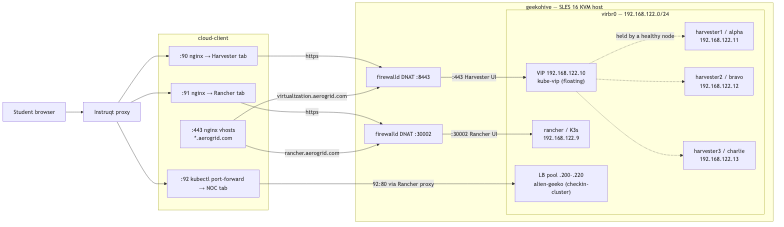
Editable source: assets/diagrams/rodeo-network-ports.mmd
The diagram shows the full path from a student browser through Instruqt cloud-client nginx tabs, host firewalld DNAT on geekohive, and virbr0 guests (VIP, Harvester nodes, Rancher, optional LB pool).
VM IPs/user for Python-side ops (ssh, restart, status, cluster waits) come from profile default_cfg() + plan vms (profile-driven in TUI panels too). Full vm_nodes (MACs/UUIDs/flavors + provisioning) still from roles/vms/defaults/main.yml (Ansible side). Custom topologies / single inventory source on the roadmap (Phase C). TUI LogsPanel and phase focus now derive VM list from cfg/profile instead of hardcodes.
Harvester install via iPXE (not ISO-first boot)
Harvester 1.8.1 requires UEFI; legacy BIOS PXE is not supported. The pxe_server role provisions network boot on virbr0:
UEFI firmware (empty disk, no bootloader)
  → DHCP from dnsmasq on 192.168.122.1
  → Stage 1: boot ipxe.efi (TFTP)                  [dhcp-boot tag:!ipxe]
  → Stage 2: ONE generic boot.ipxe over HTTP       [dhcp-boot tag:ipxe]
  → boot.ipxe chains to the per-node script by MAC: :8080/ipxe/mac-<mac>
  → kernel + initrd + squashfs over HTTP (installer console logged to ttyS1)
  → unattended install (config YAML at :8080/config/config-harvesterN.yaml)
The per-node routing is MAC-based, not per-host dnsmasq tags: libvirt already
writes a <host mac=…> for each node's IP, and a second dhcp-host for the same
MAC (to set a routing tag) is silently ignored by dnsmasq, so all iPXE clients
get one boot.ipxe, which selects the node script by ${net0/mac:hexhyp}.
VM XML boot order is disk first, management NIC second. On first boot the qcow2 is empty, so UEFI falls through to NIC PXE. After install, reboots go straight to disk. ISO CDROMs remain attached as fallback; RancherPhase ejects them once the cluster is up.
On-disk layout after pxe_server:
| Path | Purpose |
|---|---|
/var/lib/libvirt/dnsmasq/ipxe.efi |
Stage-1 UEFI loader (TFTP) |
/srv/harvester-pxe/harvester/ |
vmlinuz, initrd, rootfs.squashfs, ISO symlink |
/srv/harvester-pxe/ipxe/boot.ipxe |
Generic stage-2 script (chains by MAC) |
/srv/harvester-pxe/ipxe/mac-<mac> |
Per-node iPXE scripts (named by mgmt MAC) |
/srv/harvester-pxe/config/config-harvester{N}.yaml |
CREATE/JOIN Harvester config (0644 so nginx serves it) |
Ref: Harvester v1.8 PXE boot install.
SLES 16 / Instruqt constraints (do not break)
Documented in role comments and CONTEXT.md.
- NetworkManager only: wicked removed; virbr0/vnet* marked unmanaged
- Modular libvirt: disable monolithic
libvirtd; enable socket-activated daemons - libvirt-guests off during build: stalls
network-online.targeton Instruqt save/reboot - virbr0 autostart false until cluster: same boot-order issue
- firewalld rules permanent, daemon stopped during Ansible: protects Instruqt mgmt NIC
- 90s gap between harvester2 and harvester3: etcd join race prevention
- OVMF 4MB non-SecureBoot: 2MB images gone on SLES 16
- xorriso: not genisoimage
Files to treat as fragile:
roles/kvm_host/tasks/libvirt.ymlroles/vms/tasks/network_setup.ymlroles/vms/defaults/main.yml(MACs ↔ DHCP ↔ Harvester config)roles/pxe_server/templates/network-pxe.xml.j2(two-stage iPXE dnsmasq routing)roles/pxe_server/templates/ipxe-node.j2(UEFIinitrd=kernel arg required)engine/cluster.py(ETCD_JOIN_GAP, virbr0 start before VM boot)
Security model (lab scope)
Single-tenant training lab, not production.
| Choice | Reason |
|---|---|
| TLS verify off | Self-signed Harvester/Rancher certs |
SSH StrictHostKeyChecking=no |
Ephemeral lab VMs, host key baked in cloud-init |
security_driver = "none" |
Nested KVM on SELinux-enforcing SLES 16 |
| SELinux permissive (kvm_host role) | Nested virt lab compatibility |
| One host ed25519 key in all guests | Deployer drives SSH/API setup |
| DNAT on host | Attendees reach UIs via host IP |
Protected: secrets in chmod-600 files, no_log on password tasks, random passwords/tokens from rodeo init, fail-closed validation.
Testing & CI
| Test area | Purpose |
|---|---|
test_config.py |
Merge, Jinja, -P, secret resolvers, validation |
test_runner.py |
Pipeline events, instruqt guard, vars file |
test_ansible_consistency.py |
Profile ↔ Ansible defaults ↔ plan template drift |
test_ansible_vars_contract.py |
Vars file keys match Ansible consumers |
test_pxe_integration.py |
Playbook order, pxe_server role, boot order, JOIN VIP guard |
test_cluster.py / test_rancher.py |
Poll loops, timeouts, parsing |
test_plan_cmd.py |
Plan diff command |
GitHub Actions: .github/workflows/ci.yml: Python 3.10 + 3.12 (ruff, pytest); ansible-lint job on 3.12.
Live KVM regression is still manual (or geekohive) before touching MAC/DHCP/ISO chain.
Extension points
| Add… | Where |
|---|---|
| New tech platform | New RodeoProfile + definition.yaml, then profiles.register_profile() (in-tree: profiles/__init__.py; out-of-tree: a rodeo.plugins entry point). Its builder attribute (title, base profile, capabilities it provides, note) offers it in the Rodeo Builder |
| New deployment_target | host_context.register_host_context(name, overlay), validation, --target, prompt, plan shaping and the Rodeo Builder's target choice all follow; add up_cmd.py auto-detection only if the target is probeable |
| Profile success screen | Override RodeoProfile.success_extra_sections() / success_next_steps(), success.py renders URLs/credentials, the profile owns the narrative |
| New Python phase | profiles.base.register_stream_phase() + a stream_* generator on DeployRunner + add to profile.phases |
| New host provider | providers.registry.register_provider() with a factory returning a HostProvider |
| Third-party plugin | A package with a rodeo.plugins entry point calling the register_* APIs, discovered lazily on the first lookup miss (see rodeo/plugins.py) |
Plugin seams (rodeo/hooks.py) |
No-ops until a plugin registers. register_event_sink(cb): one redacted record per DeployRunner event (rodeo's own built-in sink, rodeo/events_log.py, appends them to <lab>/.rodeo/events.jsonl; schema in docs/runbook.md) (ts, lab, phase, kind, text, rc/elapsed when present); known secret values (resolved ?? values, secrets-file values, generated secrets, credential literals, URL userinfo) are masked, and a failing sink is logged, never fatal. register_operation_hook(fn): what begin_operation(lab_dir, action) returns, called by up, deploy (not --check), mutating MCP calls, Builder deploys and fleet up/deploy/provision/retry/deprovision; None changes nothing. register_mcp_tool: see docs/mcp.md. A plugin is never the safety layer: one that fails to load is skipped |
| New CLI command | commands/*.py + register in cli.py |
| New MCP tool | One row in mcp/tools.py (READ_TOOLS or WRITE_TOOLS): subcommand, typed Args, fixed flags. Schema, dispatch and the --allow-write gate follow; see MCP server |
| Host OS support | hostos.py (which OSes host labs), install.sh role detection, install_deps.py, and kvm_host role conditionals |
| New workshop/demo | Separate repo: rodeo-plan.yaml (type + deployment_target) + lab guide + host setup docs |
| Multi-host workshop fan-out | rodeo/fleet/ + workshop.yaml: see Fleet; do not multi-host the phase engine |
Credential stores of other engines
The builder's credentials come from rodeo's own store (rodeo/builder/vault.py)
and from the stores of other engines, read-only (rodeo/builder/engine_credentials.py,
today the lab-in-a-box engine's). Reusing the credentials an engine keeps in its own
store needs, from that store:
- Engine name: every credential listed carries
engine, the engine whose store holds it (rodeofor rodeo's own), shown on the Settings page. - List without values: id, name, type, created and last used; never a value or anything that decrypts one.
- Application: which provider or service each credential is for, shown on
the Settings page (lab-in-a-box: the file name's
<application>-part). - Open with a password: values only after that credential's password, asked each time; delete only after the password too.
- Type mapping: from the engine's credential types to rodeo's
(
vault.TYPES), so Use stored… offers them for the right plan secrets. - Root-only access: read and written through the root helper
(
rodeo-builder-helper), never by the web server user.
Fleet (multi-host workshops)
For N identical student/instructor KVM hosts, the laptop runs rodeo fleet over
OpenSSH. Each remote still executes single-host rodeo up / doctor / status.
Shipped: JSON reports, fan-out, deploy/retry/access/diagnose, AWS provisioning,
open-access for students and the claim portal. Next host providers: GCP, Vultr
Bare Metal, Hetzner Cloud (planned stubs today). See Fleet.
Related documents
| Document | Audience |
|---|---|
| User guide | Workshop operators deploying labs |
| Fleet | Multi-host workshops, AWS provisioning and the claim portal (roadmap) |
| MCP server | Driving rodeo from an agent or editor over MCP |
| ROADMAP.md | Planned declarative-deployment features |
| CONTEXT.md | Full project context for AI/developers |